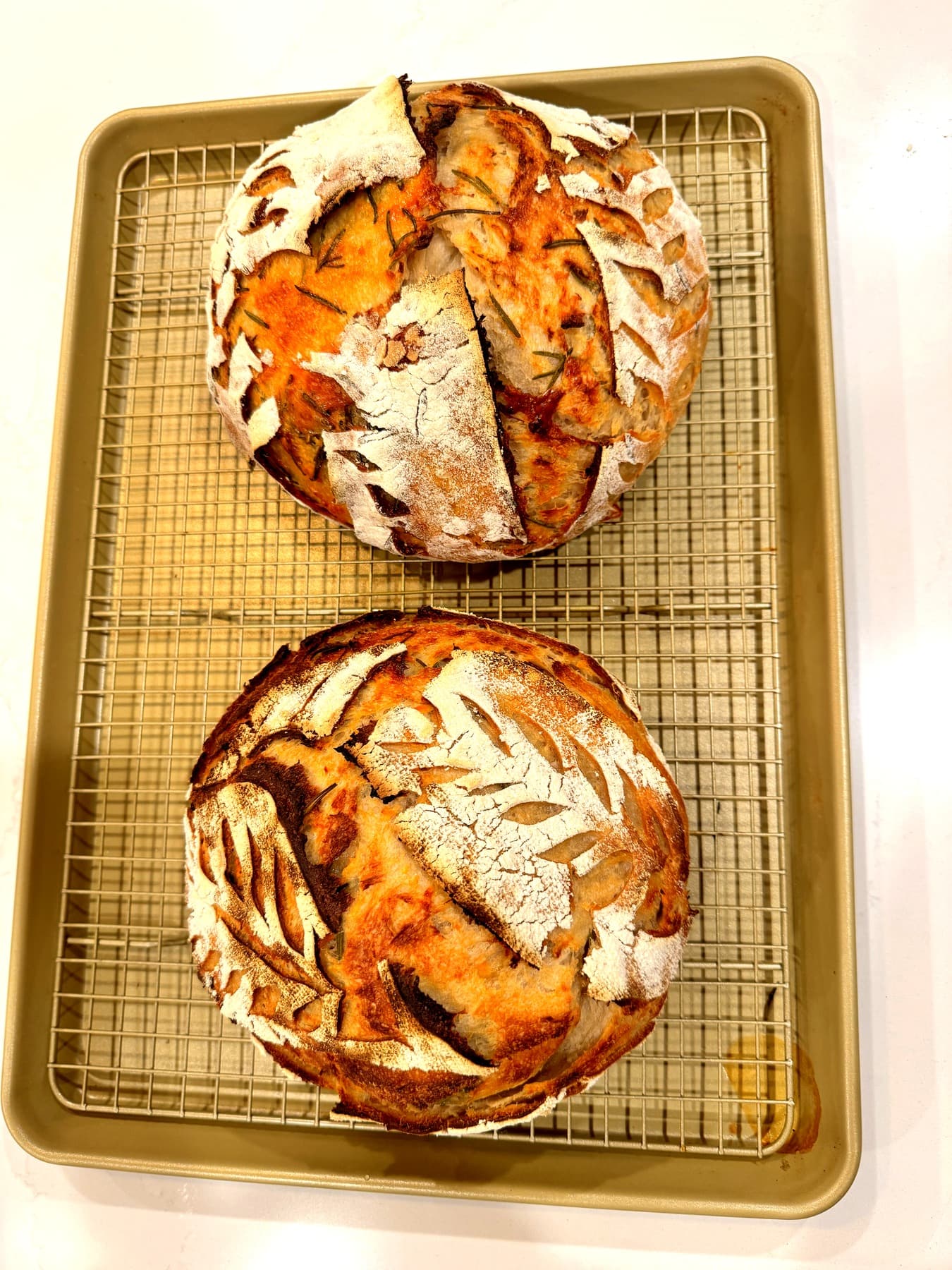
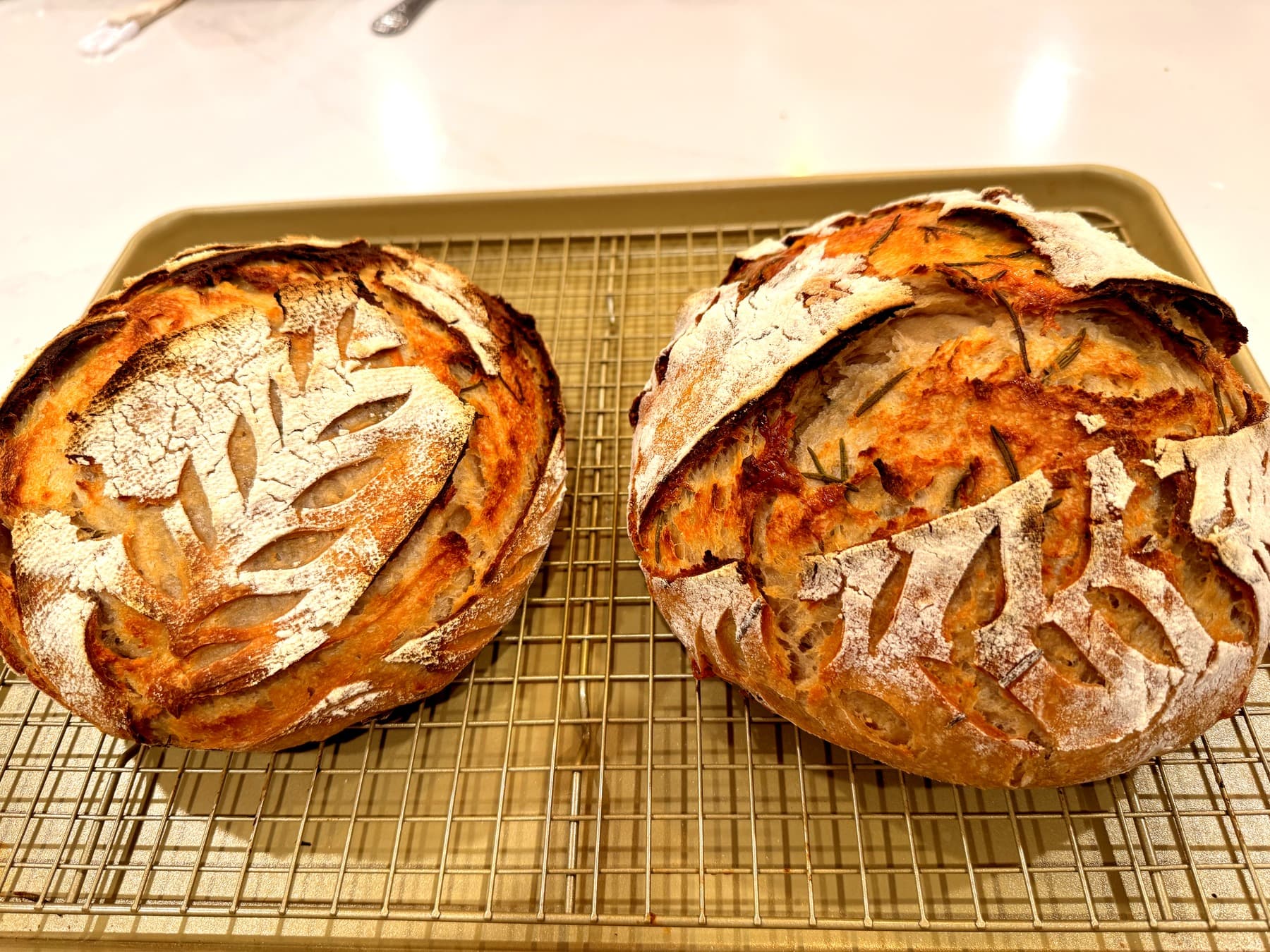
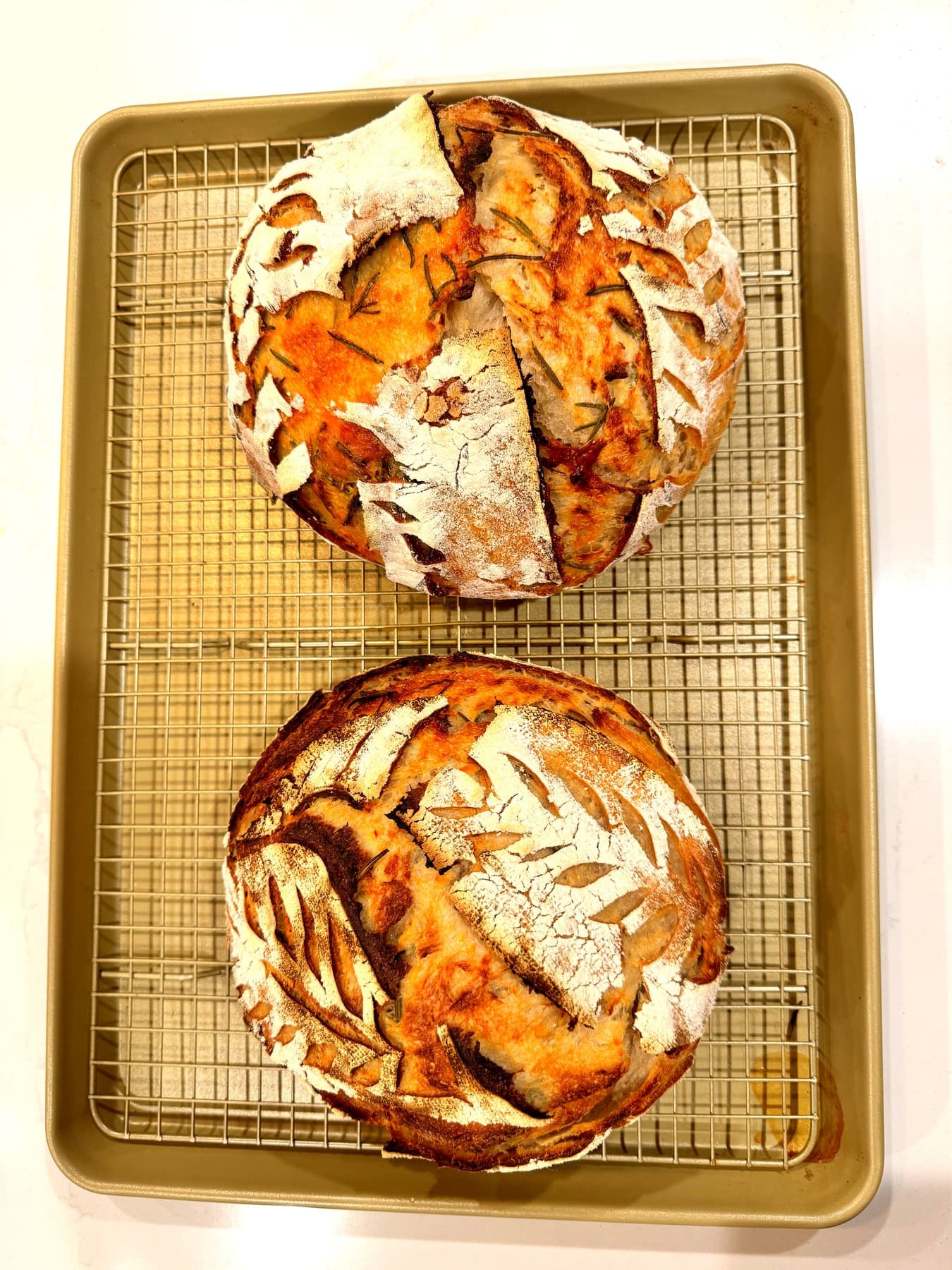
There's a particular moment when this loaf comes out of the Dutch oven. The lid lifts, and the kitchen fills immediately with the smell of toasted Parmesan and rosemary. It's one of the most satisfying moments I've had in bread baking.
This is the first inclusion loaf I ever made. The combination felt obvious in theory but I wasn't sure how the cheese would behave during baking. The answer, it turns out, is beautifully. It melts into the crumb, creates golden pockets throughout, and the exposed cheese on the surface caramelizes against the Dutch oven heat into something almost nutty.
Formula
| Ingredient | Weight | Baker's % |
|---|---|---|
| Bread flour | 450g | 90% |
| Whole wheat flour | 50g | 10% |
| Water | 390g | 78% |
| Starter (active) | 100g | 20% |
| Fine sea salt | 10g | 2% |
| Parmigiano-Reggiano, finely grated | 80g | — |
| Fresh rosemary, finely chopped | 2 tbsp | — |
| Black pepper, cracked | 1 tsp | — |
A Few Notes on the Inclusions
Parmesan. Use Parmigiano-Reggiano if you can, not a generic "Parmesan." The real thing has a crystalline, complex flavour that cheaper versions don't. Grate it finely so it distributes evenly rather than clumping.
Rosemary. Fresh and finely chopped, not dried. Dried rosemary turns dusty and slightly bitter in the oven. Fresh rosemary blooms into something fragrant and green. Chop it finer than you think you need to. The smaller pieces distribute more evenly and you get rosemary in every bite rather than occasional large pieces.
Pepper. Optional, but worth it. Cracked black pepper adds a gentle heat that anchors the whole loaf in the savory direction.
Mix and Bulk Fermentation
Follow the same process as the country sourdough. The only difference is when you add the inclusions, which is during lamination, about 30 minutes into bulk fermentation.
To laminate, wet your work surface lightly and turn the dough out. Gently stretch it into a large rectangle, as thin as you can without tearing. Scatter the Parmesan, rosemary, and pepper evenly over the surface. Fold the dough back over itself from both sides (letter fold), then fold from top and bottom. Return to the bowl and resume your stretch and fold schedule.
The lamination incorporates the inclusions evenly without deflating all the fermentation gases.
Shaping and Cold Proof
Shape as you would a standard loaf. The Parmesan will have distributed throughout the dough by this point. Shape gently to avoid tearing the dough around the cheese pieces.
Cold proof overnight, 12 to 16 hours.
Baking
500°F Dutch oven, covered for 20 minutes, then uncovered at 460°F for 20 to 25 minutes.
The Parmesan on the surface will caramelize significantly. Don't be alarmed when the crust looks darker than usual. That's the cheese, not burning. You'll smell the difference.
Serving
This loaf was designed to be eaten warm, in thick slices, with no embellishment beyond good olive oil for dipping. It's also exceptional alongside a simple tomato soup, or as the bread in a grilled cheese sandwich. The parmesan already embedded in the crumb amplifies everything.
It keeps well for two days, though the crust softens by day two. I often slice the remainder and freeze it. It toasts beautifully from frozen.
What's inside
Photos
Tasting Notes
Golden crust, crackly and dark wherever the Parmesan hits the surface. The crumb is open and savory. The rosemary reads earthy and warm rather than sharp, and the cracked pepper comes in at the finish.